Email Marketing Best Practices for Healthcare Audiences
It is the first Monday of the quarter. Your team loads a freshly bought list of 8,000 cardiologists, oncology directors, and hospital supply leads into the platform, writes a clean subject line, and hits send.
By Friday, the report is in: a bounce spike, a reply rate under one percent, and a sender score that just slipped. The instinct is to blame the copy. The copy is almost never the problem.
Here is the problem. Almost one-third of physicians change practice location or affiliation every single year (CarePrecise). The list you bought in January will be wrong for hundreds of contacts by spring, and a quarter of it will be fiction by December. You did not send a weak campaign. You sent a strong campaign to people who left.
Key Takeaway: In B2B healthcare email, your results are decided before you write a word. The winning teams treat every send as something that must pass four gates in order: Accuracy, Relevance, Inbox, and Trust. Fix the gates in that sequence, because a brilliant email to a stale, mis-segmented, undeliverable list is just expensive noise.
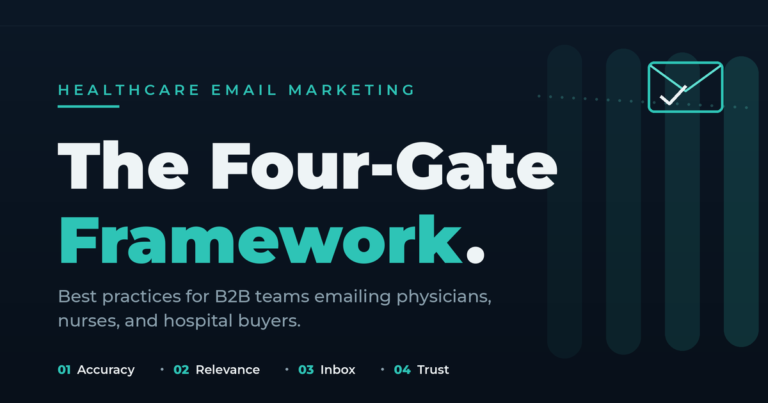
Every email you send to a healthcare professional has to clear four gates before it can earn a reply.
Gate 1: Accuracy. Is this person still here?
Gate 2 is Relevance: Does this match their clinical reality?
Gate 3 is the Inbox: will it survive an institution’s mail security?
Gate 4 is Trust: does it respect a clinician’s time and the rules that actually govern your send? Skip a gate, and everything downstream of it is wasted. Here is how to pass all four.
Gate 1: Why Your Healthcare Email Breaks Before You Write a Word
The single highest-leverage decision in healthcare email is made before the subject line exists: how fresh your contact data is on the day you press send.
Healthcare contact data decays faster than any other B2B vertical. Providers change jobs, practices merge, and health systems consolidate constantly, so a record that was perfect last quarter quietly rots. The pace is structural, not occasional.
The HRSA 2025 State of the US Health Care Workforce report documents continued large-scale provider movement across markets and care settings, with the nurse practitioner workforce alone projected to grow 35 percent between 2024 and 2034, much of it through regional migration (HRSA, 2025).
The Numbers: Research published via PubMed Central in 2024 found that even the best-performing physician directories hit only about 86 percent address accuracy, and many widely used sources performed far worse. At that error rate, one in seven of your “verified” contacts is wrong on day one, before any natural decay sets in.
This is also where the 2026 reality of automation bites hardest. An AI sequencing tool firing six touches at a cardiologist who retired in March is not efficient outreach. It is an expensive random-noise generator that punishes your sender’s reputation with every bounce. Your AI does not fix bad data. It scales it.
The fix is to stop buying a list and start maintaining a verified contact layer. Anchor every record to the National Provider Identifier (NPI), the federal ID assigned to every licensed US provider, and cross-reference against NPPES, the federal registry of nearly five million provider records that updates monthly and is the only US provider source whose accuracy is protected by law (providers must report changes within 30 days).
Then verify on a real cadence: weekly or monthly refresh beats a quarterly batch in a market that moves this fast. Before you write Gate 2, you have to win Gate 1.
Gate 2: Why “Doctors” Is Not a Segment
If your list segments by “physicians” or even “cardiologists,” you are sending a generic email to a generic audience, and healthcare professionals can smell generic from the preview pane.
The reason matters. A clinician’s daily reality is defined by subspecialty, practice setting, and purchasing authority, and those three variables change what you should say entirely. An interventional cardiologist in a 600-bed academic system and a general cardiologist in a three-person private group share a label and almost nothing else. One answers to a value analysis committee and a group purchasing organization. The other signs the check itself. The same email cannot speak to both.
Segmentation is also the lever with the clearest payoff in this vertical. Healthcare email click rates sit near the bottom of all industries, around 0.88 percent in some benchmark sets (ActiveCampaign, 2025), which means relevance is the entire game.
The Numbers: Segmented healthcare email campaigns deliver click-through rates roughly 101 percent higher than unsegmented sends (Promodo). Nothing else in this playbook doubles a metric from a single change in setup.
Build your segments on the variables that actually drive a clinician’s decision: specialty and subspecialty, practice type (independent, group, or hospital-employed), organizational affiliation, seniority, and role in the buying process.
A Chief Medical Officer evaluating an enterprise platform and a staff nurse who will use it daily need different messages on different days.
Segment by clinical and commercial reality, not by the job-title bucket that came with the list. Once the right message is reaching the right person, the next question is whether it reaches them at all.
Gate 3: The Hospital Firewall Is a Real Wall
Accurate and relevant means nothing if the message never lands, and in healthcare, your email faces two layers of gatekeeping: the major inbox providers and the institution’s own security stack.
Start with the layer that affects everyone. Since February 2024, Google and Yahoo have required bulk senders (those sending more than 5,000 messages a day) to authenticate with SPF, DKIM, and DMARC, to offer one-click unsubscribe, and to keep spam complaints below 0.3 percent, with under 0.1 percent strongly advised (MarTech; Mailgun).
This is no longer a soft guideline. As of 2026, Google and Microsoft issue outright rejections for non-compliant bulk mail, and Microsoft’s bounce reads “550 5.7.515 Access denied,” meaning your email never even reaches the spam folder (PowerDMARC, 2026).
The Numbers: Compliant senders average roughly 89 percent inbox placement in 2026, while non-compliant senders see 22 to 34 percent of their mail routed to spam, a 3- to 7-times penalty (PowerDMARC, 2026). Authentication is no longer a deliverability tactic. It is the entry fee.
Then there is the second wall, the one unique to this audience. Hospital and health-system inboxes sit behind aggressive enterprise security filtering tuned to block exactly the patterns cold outreach produces: link-heavy templates, mismatched sending domains, sudden volume to a single domain, and spammy display names. The practical defenses are unglamorous, and they work.
Warm your sending domain, keep volume to a single institution, write plain-text-friendly emails with a low link count, and align your visible “From” domain with the domain you authenticate with.
In healthcare, deliverability is earned at the DNS and firewall levels, long before it is earned in the inbox. Clearing the inbox gate gets you seen. The last gate decides whether being seen helps you.
Gate 4: HIPAA Probably Does Not Apply. The Rules That Do.
The most common compliance mistake in B2B healthcare email is fear of the wrong law, which quietly makes teams timid, generic, and ineffective.
Here is the clarification that changes how you write. HIPAA governs protected health information, which is patient data. It does not govern professional B2B outreach to a provider’s business contact information (Provyx; SMARTe).
An email from a medical device rep to a surgeon’s practice about a product does not constitute a HIPAA-regulated activity.
You are not handling anyone’s diagnosis. You are contacting a professional buyer at work, the same as in any other B2B vertical. Treating provider business data as if it were PHI is a category error that costs you nothing in safety and a great deal in performance.
The rules that do apply are concrete and worth knowing cold. CAN-SPAM governs your commercial email: accurate “From” and subject lines, a real physical postal address, and a working opt-out you honor within ten business days.
The bulk-sender requirements from Gate 3 include a one-click unsubscribe mandate. And if your data sourcing or recipients touch jurisdictions with stricter regimes, such as CCPA in California or GDPR for EU contacts, those obligations layer on top.
Know which apply to your actual audience and source your data from providers who can document compliant collection.
The Numbers: B2B email open rates average around 39.5 percent (HubSpot, 2025), and the healthcare professionals clearing that bar are reading at a desk between patients, not browsing. You get one screen of attention. Spend it on value, not on a pitch.
What earns the reply at this gate is respect for a clinician’s time. Lead with a specific, useful reason to read: a peer benchmark, a regulatory change that affects their service line, or a clinical or operational insight they can use this week.
Time sends for the professional workday rather than the consumer weekend, keep frequency restrained, and make every email survive the “so what for a busy specialist” test. Compliance keeps you legal. Relevance and brevity are what make a clinician choose to reply.
The List Was the Strategy All Along
The uncomfortable truth running through all four gates is that healthcare email is not really a copywriting discipline. It is a data discipline wearing a copywriting costume.
The best subject line in the world cannot reach a physician who has left, cannot be relevant to a segment of one called “doctors,” cannot pass a firewall it was never built to clear, and cannot earn trust it never tried to keep.
Which means the foundation under the Four-Gate Framework is not a campaign. It is a continuously verified provider intelligence layer: NPI-anchored, freshness-maintained, and segmented to clinical and commercial reality. A static list cannot do this because it begins decaying the moment you download it.
The teams that win this channel stopped thinking of contact data as a file they buy and started thinking of it as infrastructure they maintain, the same way they maintain their sending domain or their CRM.
So before you brief another healthcare campaign, run one diagnostic instead.
Take your top 500 healthcare contacts and run a decay audit: cross-reference them against NPPES, check what share have moved, retired, or changed roles in the last twelve months, and recompute your real reachable universe. That number, not your list size, is your actual addressable market.
Fix Gate 1, and the other three finally have something worth sending.